Carmen Guarner Giner
Sara Alcaraz Belda
Meritxell Villalonga Adell
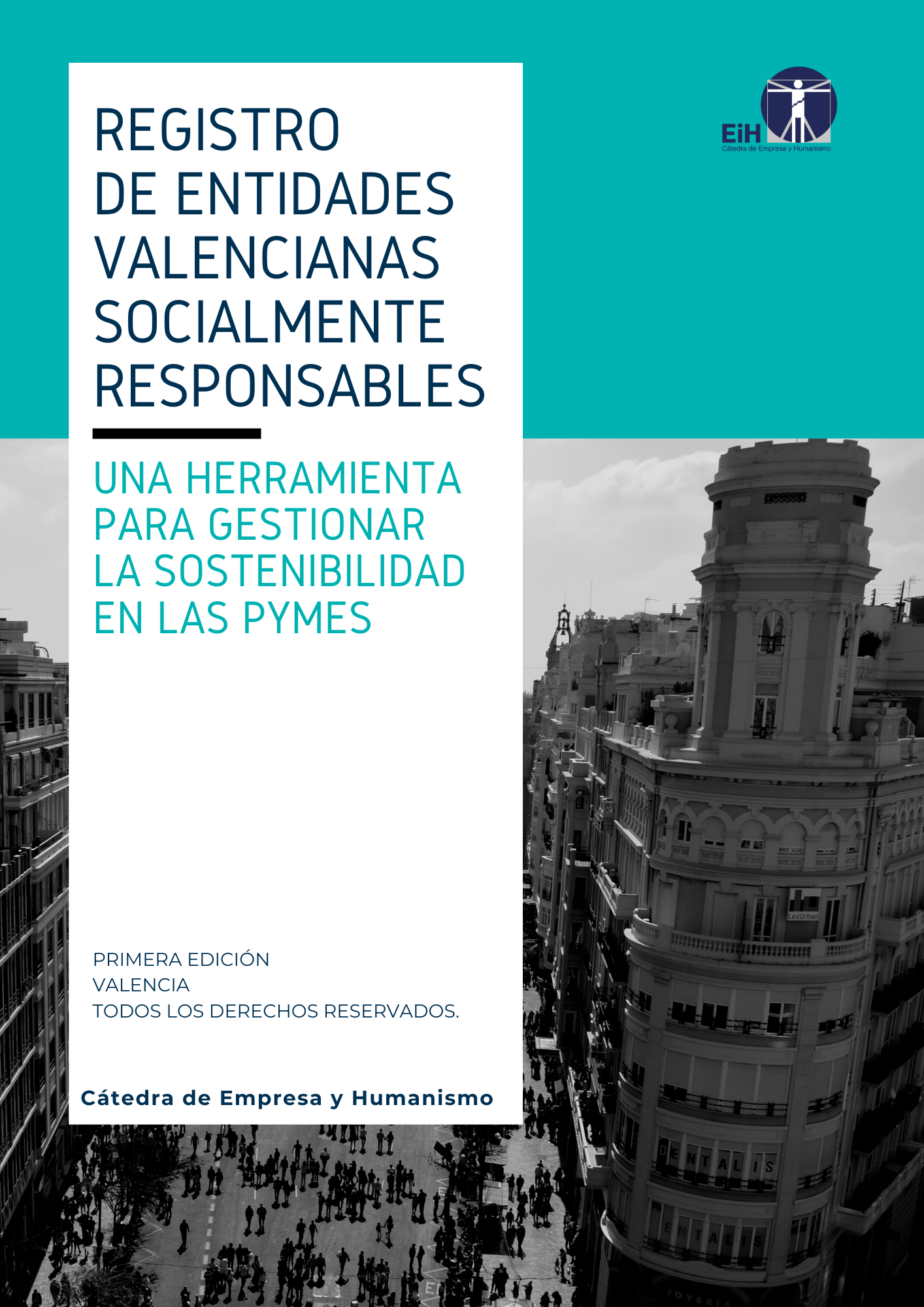
The Chair of Business and Humanism of the University of Valencia has published the first edition of the Guide 'Registry of Socially Responsible Valencian Entities: A tool to manage sustainability in SMEs'. In it you will find everything you need to know about the REVSR.
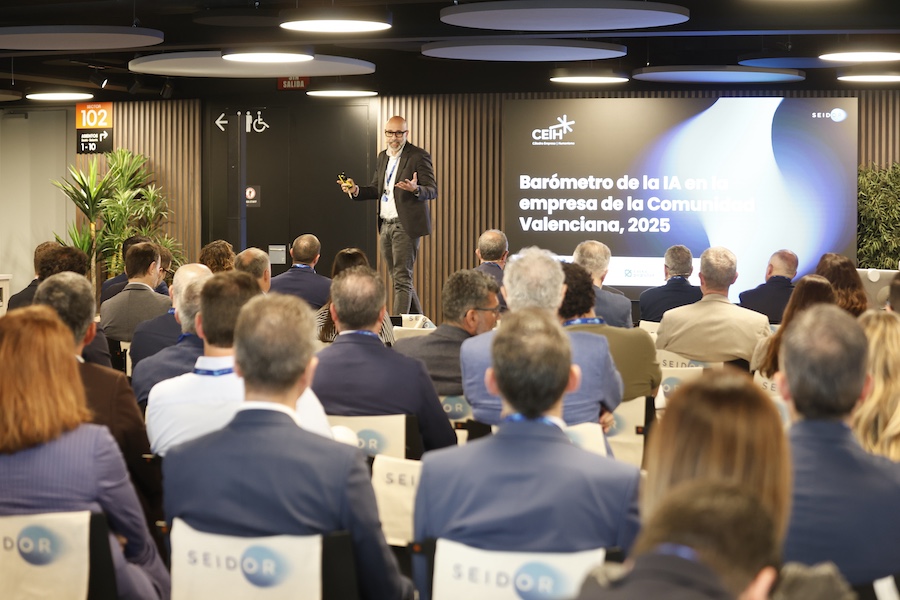
The second edition of the Digital Transformation Barometer for Companies in the Valencian Community and Murcia, organized by the Chair of Business and Humanism of the University of Valencia joinly with SEIDOR, has been a resounding success. The event has exceeded all expectations, marking a significant milestone in the promotion of digital transformation and business innovation in the Valencian Community.
This academic document presents an analysis of the degree of digital transformation of 183 companies that are already immersed in this process of comprehensive organizational change. It also describes the degree of data orientation of the person leading the organization's digital transformation process. Data orientation is an approach that emphasizes the importance of collecting and analyzing data to develop ideas and knowledge. Understood as a quality of people in management positions, data orientation is defined as the ability to make effective decisions based on the organization's ability to quickly and effectively obtain information about organizational performance, user behavior, and the environment. Data orientation is key to making decisions based on the analysis of information provided by big data analytics and the management of the correct use of new technologies that drive the digital transformation process of organizations.
This academic document examines the content of 50 corporate social responsibility reports published in 2020 and analyses the most frequently repeated themes. This is done from a dual perspective: on the one hand, from the dimensions of social responsibility and sustainability, and on the other, from the areas that allow us to understand a company's actions. The emotional state that these reports try to communicate is also analysed.
This book has a dual objective with regard to corporate sustainability: on the one hand, to provide tools to help companies integrate the principles of sustainability into both their strategic management and their daily operations; and, secondly, to raise awareness of the importance of preparing and disclosing non-financial reporting and sustainability reports, not only to comply with the growing regulations on the subject, but also to meet the high expectations that stakeholders have of the company as a key organisation in promoting sustainable development.
Additionally, this work includes a diagnostic study developed at the Paterna Technology Park to learn in greater detail about the practices in terms of sustainability, information transparency and non-financial reporting of the companies and other organizations that are hosted there.
On November 11, 2021, Cátedra de Empresa y Humanismo together with Seidor, presented the results of the first barometer on the State of the Digital Transformation in Companies in the Valencian Community and Murcia.
The second part of the research carried out by Consolación Adame, Eva Caplliure and Consuelo León, focuses on the impact that teleworking has had on the management of family relationships.
They study how the work and family spheres have interacted, placing special emphasis on possible differences perceived due to gender. They also study to what extent conciliation was affected, that is, whether there was an increase in conflicts when trying to balance both spheres.
Non-financial reporting is becoming a key element in addressing issues such as climate change and social inclusion. Companies and their stakeholders need more complete, comparable and robust information to make decisions.
Through these training capsules, our Director Tomás González, talks about the objectives of non-financial information, the main differences compared to financial information and which factors are becoming more relevant in this area.
Non-financial reporting is becoming a key element in addressing issues such as climate change and social inclusion. Companies and their stakeholders need more complete, comparable and robust information to make decisions.
Through these training capsules, our Director Tomás González, talks about the objectives of non-financial information, the main differences compared to financial information and which factors are becoming more relevant in this area.
In a situation in which all economic sectors have been affected by the effects of COVID-19, companies, regardless of their size, have encountered problems in accessing sources of financing.
On this occasion, José María Badía, General Manager of AFIN - Sociedad de Garantía Recíproca, talks to us about the support lines the organization has been developing to benefit SMEs and the self-employed during the pandemic, explaining the advantages for entrepreneurs, as well as the requirements and application procedure.
This publication contains the results of research carried out in the context of the lockdown and mobility restriction measures caused by COVID-19 throughout 2020, in terms of teleworking and levels of satisfaction with it.
One of the most challenging issues facing SMEs and self-employed workers is gaining access to financing.
An alternative that provides advice, training and business support is the Reciprocal Guarantee Society of the Valencian Community.
Its General Manager, José María Badía, explains how AFIN - SGR helps businessmen and women to obtain guarantees to access sources of financing from private and public entities.
The mission of managers and people managers is to act as a gardener, creating the conditions so that in the garden that is the organization, people flourish, give their best while contributing to productivity, all within the framework of being happy doing their job.
In his book "Motivation in organizations and meaning at work," Manuel Guillén presents a new approach to more humane people management, creating a map of motivations that helps people find greater meaning in life and work.
This book addresses the definitions of financial literacy and education in a broad sense, reviewing the criticisms and praises that rest on them in order to understand the need for the introduction of financial education in pre-university education and its possible continuity in higher education studies in the economic branch, taking as a diagnosis base the empirical exploitation of a database of 1,282 pre-university students in the Valencian Community.
This publication aims to make it easier for companies to familiarise themselves with, prepare and use sustainability reports and non-financial information statements. It also carries out a prospective analysis of where legislation should move in the future, paving the way for the preparation of reports that are not only effective and responsive, but also efficient and planned.
This work, which follows on from the one we published in October 2019, provides empirical evidence about the relationships between information transparency (materialized in the RNF), organizational performance and improvement of relations with interest groups, using a multi-method approach.
In November 2021, the first version of Viure was held, the Responsible Consumption Fair organized by the General Directorate of Commerce and Consumption of the Council of Sustainable Economy, Productive Sectors, Commerce and Labor.
This initiative has the motto 'Conscious purchasing for a better planet' and aims to disseminate among citizens the existence of products, services and activities of companies and entities that promote and enable responsible and local consumption, making possible, at the same time, a truly social and supportive economy.
The Chair of Business and Humanism presented the results of the recent study: What concept do university students in the Valencian Community have about Social Responsibility?
The new competitive context is guided by innovation and by the principles of sustainability, where the region is established as the optimal level of industrial, governmental and technological support. Regional innovation systems are therefore considered a key instrument in the learning and management processes of innovation.
This practical guide aims to help companies that wish to do so to develop corporate reporting systems that integrate financial and non-financial information, thereby helping to build a more humane productive environment governed by trust, information transparency and social responsibility, and a competitive environment that seeks to create value by competing for intangibles.
Economic progress has been accompanied by a series of harmful social and environmental effects that have often been overlooked. In order to alleviate such unfavourable results, the sustainability paradigm is established as one capable of addressing development from an integrative perspective of the economic, social and environmental dimensions.
The growing concern in society about the levels of environmental degradation has favoured the proliferation of territorial agglomerations that reflect the need to align economic and social objectives, and that diversify the classic types of industrial parks. This work aims to create a theoretical framework for the study of Ecological Industrial Parks.
The purpose of this paper is to study corporate social responsibility and the effect of its application on the consumer. To do so, economic literature is applied to the practical field, focusing on the industrial bakery and pastry sector in Spain. By analysing two companies in the sector, a social responsibility index is created that will determine which company is more socially responsible.
In recent years, Corporate Social Responsibility (CSR) has taken on special relevance due to the changes that have taken place in society, which demands that companies find solutions to the effects that these produce, which is why they have been taking sides in this aspect, taking into account the interests of their stakeholders. to alleviate their effects and contribute to the community in which they operate.
This booklet offers a review of the importance of the social enterprise as an innovative economic phenomenon in the world of entrepreneurship, analyzing its empirical presence, its conceptual aspect, the types of forms it takes, the functions it can perform in the economic world and in society, and its main aspects and challenges in management and reporting.