

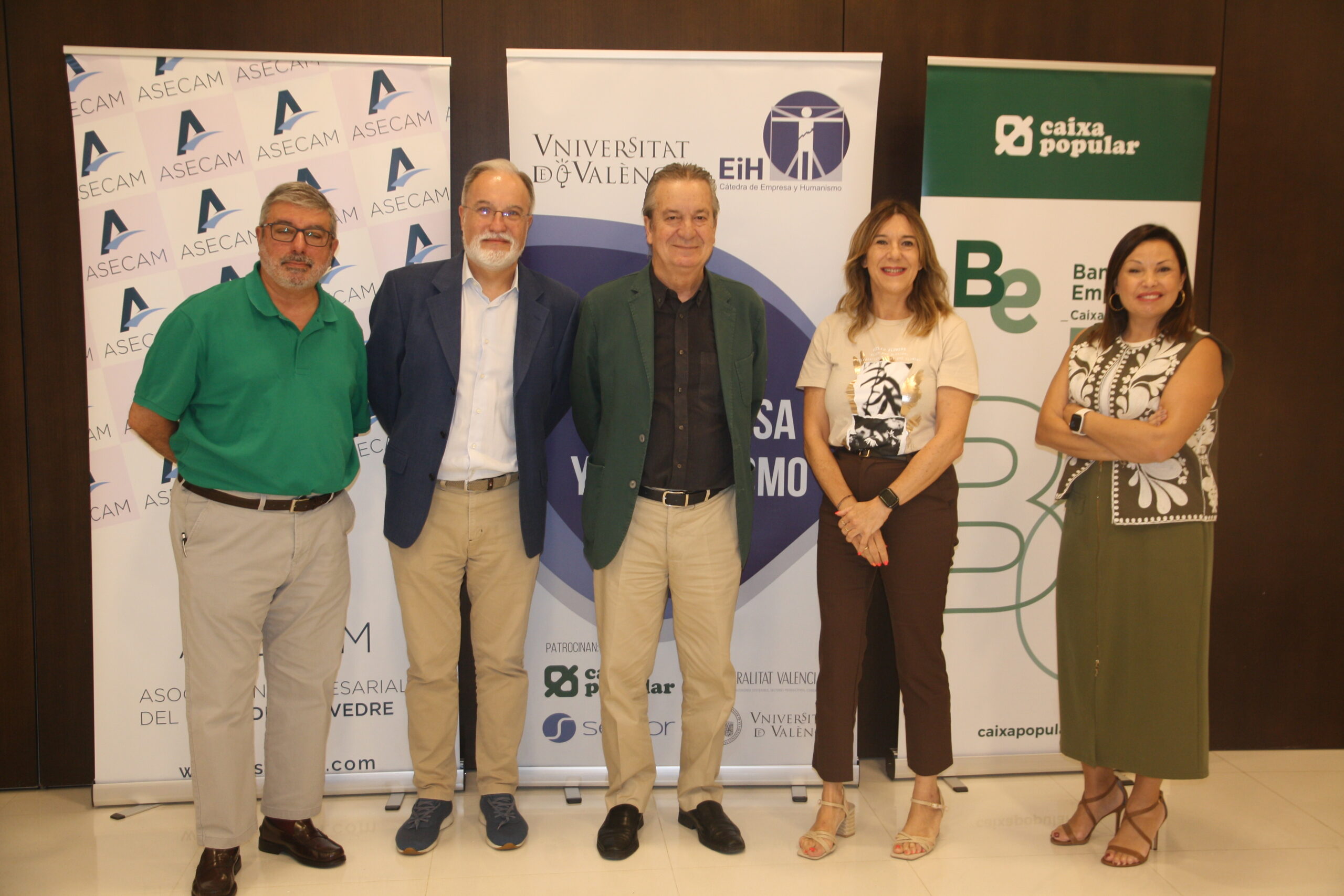
On the occasion of the training seminar program for companies that carry out the Chair and Popular Bank, this September 20th in collaboration with the Camp de Morvedre Business Association (ASECAM), the conference on the Registry of Socially Responsible Valencian Entities, with the participation of Paco Álvarez, President of the Spanish Federation of the Economy of the Common Good and international expert on sustainability issues; and Jesus Valero Balaguer representing the technical team of the Directorate General of Economy of the GVA in charge of REVSR.
At the opening of the event, Paco Alós Alabajos, Director of Corporate Social Responsibility and Institutional Relations at Caixa Popular, highlighted the importance and urgency with which SMEs must begin to work on ESG aspects since regulations are already being implemented. For example, the recent requirement to have a whistleblower channel for companies with more than 50 employees.
For its part, Tomas Gonzalez Cruz, director of the CEIH, insisted on not waiting for it to become mandatory for SMEs, but on the contrary, understanding the meaning and benefits of sustainability and taking action, since it is already indirectly affecting them, either by being inserted in a supply chain or by pressure from the financial sector.
Next, Paco Álvarez He began his speech by reflecting on society's perception of companies and the foundations that underpin sustainability. “A company needs customers, suppliers, financing. It is located in a physical place where it generates some impact. Therefore, everything related to stakeholders or interest groups justifies the entire concept of sustainability.”
He then summarised the sequence and status of the European directives on sustainability, including the NFRD, which was recently amended by the CSRD and is currently awaiting transposition in Spain.
CSRD Highlights:
- It replaces the NFRD. For companies with 250 or more employees and includes listed SMEs (around 49,000 companies).
- It sets new European reporting standards (ESRS).
- It reinforces aspects related to the environment, social sphere and human rights (JURI).
- It is in line with the European Green Deal and the UN SDGs.
- Companies that were already compliant with the NFRD will have to implement the directive in 2024, those that were not in 2025, and listed SMEs in 2026.
- SMEs in general are advised to complete the (simplified) reports that EFRAG is preparing.
He also commented on the new initiatives that are being worked on in the EU:
The CSDDD (Corporate Sustainability Due Diligence Directive): proposal under development related to corporate governance (Corporate Governance, the G in ESG).
ESAP (European Single Access Point): a public access registry that will host the sustainability reports of companies and will be the reference for obtaining European aid, bank loans, etc.

In the second part of the day, Jesus Valero from the GVA, explained the functioning of the REVSR as well as the procedure for granting the qualification as a socially responsible entity.
The points Jesus emphasized:
- The company obtains a administrative resolution, which means that the entity acquires rights and obligations.
- The rating is saved as marginal note in the commercial registerTherefore, anyone searching for information in this registry will know the status as a socially responsible entity.
- The platform offers a simplified model of the report for entities with fewer than 50 employees. However, it recommends that entities have their own sustainability report that reflects the business reality.
- To obtain the qualification, entities must comply with certain administrative obligations, including: having filed the annual accountsTherefore, it is recommended to request the qualification after this process.
- Applications are reviewed by a joint committee made up of experts who decide on the specific situation of each entity. In case the rating was unfavorable, you will be notified so that objections can be submitted within 10 days.
- The initial self-assessment that the entity must carry out to obtain the performance indicators and scores It is not public and is valid for 30 days. within the platform.
- Recommends completing both the self-assessment and the qualification request with the same electronic signature.
- The maximum legal period to receive the resolution is 6 months, although they are resolving within 3 months.
The closing ceremony of the day was in charge of Cristina Plumed, President of ASECAM, He highlighted the work of the committee dedicated to promoting and fostering corporate social responsibility among members, as well as the environmental sustainability forum that seeks to establish mechanisms for action in favour of protecting the biodiversity of Camp de Morvedre.


