

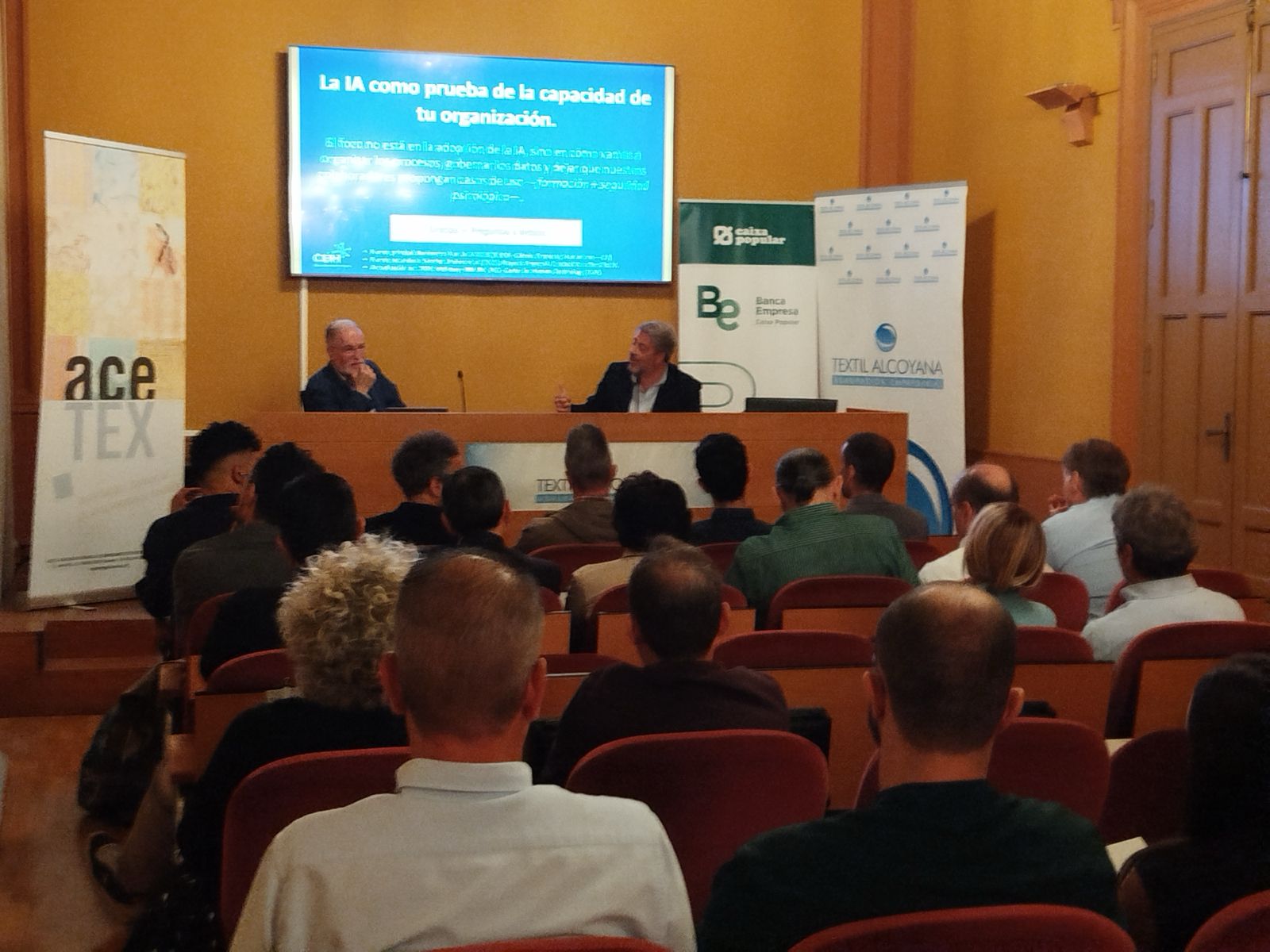
The Alcoy Textile Business Association hosted the day “Digitalization and AI with real impact: how to improve the value proposition, efficiency and margins”, an initiative jointly promoted by Caixa Popular Business Banking and the Cátedra de Empresa y Humanismo (CEiH) from the University of Valencia.
The session featured a keynote address by Prof. Dr. Thomas Gonzalez-Cruz, belonging to the Department of Business Management at the University of Valencia and director of the CEiH, who detailed the empirical evidence extracted from AI barometer in the Valencian Community (Prepared in collaboration with SEIDOR).
The SME paradox: conviction without investment
During his presentation, González-Cruz outlined one of the study's main conclusions: the existence of an "investor paradox." While Valencian companies assign a medium-to-high strategic importance to Artificial Intelligence (6.5 out of 10), The 64 % acknowledges that it will not increase its AI budget by more than 10 % in the next fiscal year.
Added to this is the silent risk of what is known as Shadow AI or "ownerless AI": a 41 % companies are driving AI tools without any centralized coordination nor clear leadership, which generates leakage of sensitive data, duplication of costs and the impossibility of measuring the real return on investment (ROI).
From Operational AI to Strategic AI: the small business's advantage
The Chair director emphasized that most organizations are using AI in a purely operational way — to automate routine tasks or improve cybersecurity (39 % of productivity-oriented use vs. only 8 % for product or service innovation) —.
However, he clarified that Competitive advantage is not determined by the algorithm, but by the redesign of processes and the human factor.. “Up to 70% of the value generated by AI comes from the reorganization of people and workflows; 20% from data management and only 10% from the algorithm itself.”González-Cruz emphasized this point, citing international reference studies such as BCG or McKinsey.
Although large corporations scale technology faster, SMEs have an agile advantage: fewer hierarchical layers and faster decision-making when management assumes leadership.
5 priorities and one checklist for the address
To prevent the erosion of critical skills in the workforce and ensure compliance with the new European regulation (EU AI ActThe day concluded with a practical ten-point plan of priorities for management committees:
- Creating value, not just efficiency: Shifting from cost-saving to seeking new market opportunities.
- Governing AI from the top down: Appoint a clear person in charge and avoid isolated pilots.
- Internal training on the market: Train middle managers to identify use cases with financial impact.
- Data protection and sovereignty: Control the flow of sensitive information and avoid absolute dependence on external providers.
- Culture of trust and psychological safety: Encourage employees to propose improvements without fear of losing their skills.
With this event in Alcoy, Popular Bank and the Chair of Business and Humanism They reaffirm their commitment to economic dissemination and support for the Valencian productive fabric, offering realistic answers to accompany companies in a digital transformation with human criteria and sustainability over time.


