

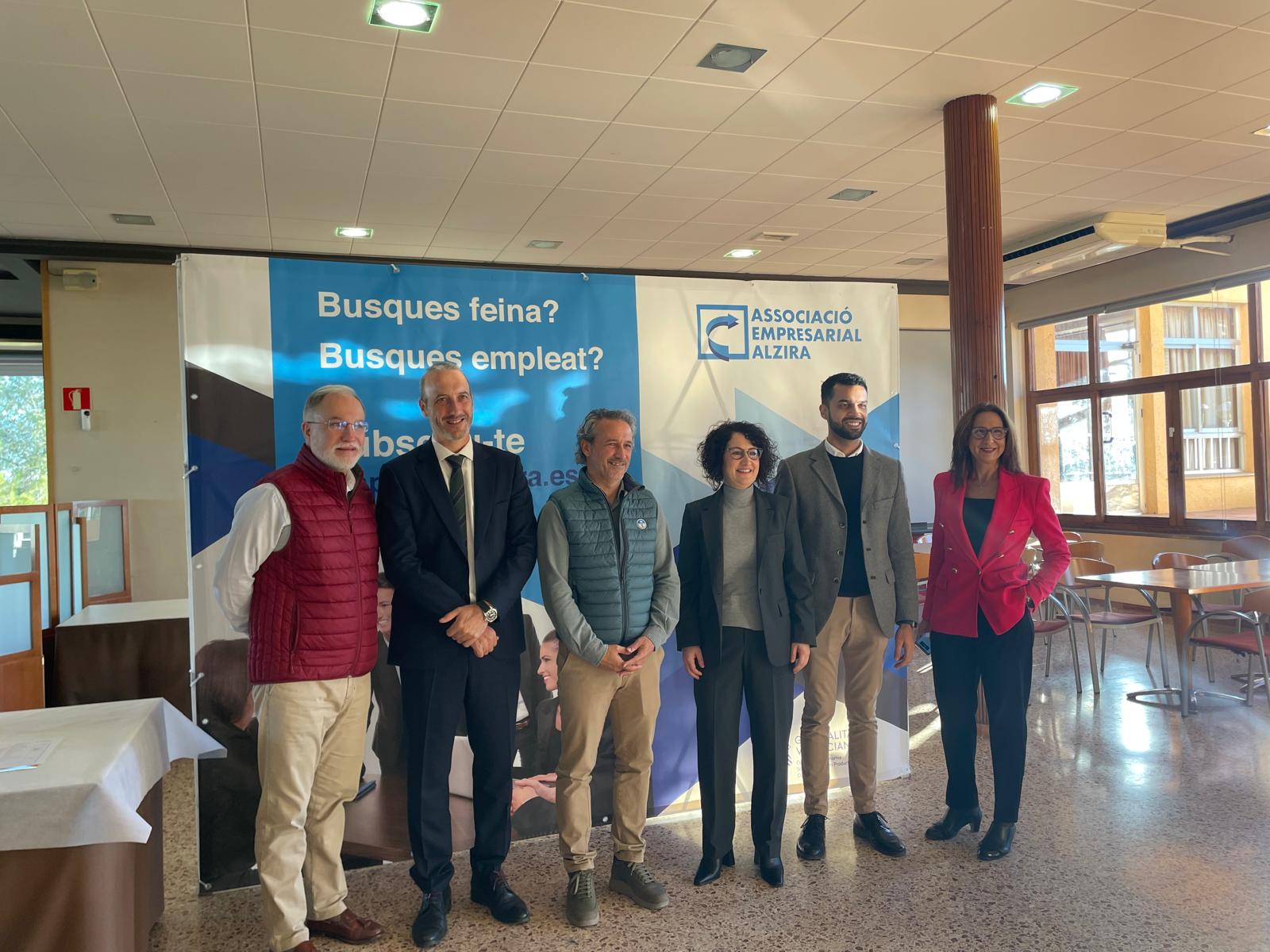
On November 27th, the Cátedra de Empresa y Humanismo of the University of Valencia participated in a new session of the Corporate Banking cycle, promoted by Caixa Popular, the Business Confederation of the Valencian Community (CEV) and the Business Association of Alzira.
The session was led by José J. Agudo, an expert in team management, leadership and organizational transformation, under the title “Leadership 3.0: People, technology and results”.
An inspiring and deeply necessary talk to understand how leadership must evolve in an environment marked by technological disruption, the arrival of new generations to the labor market and the growing demand for more humane and sustainable management models.
What is Leadership 3.0 and why does it matter today?
According to Agudo, Leadership 3.0 responds to the challenge of a context in which technology is growing exponentially, but companies still depend on people to generate value. It is no longer enough to lead based on knowledge or traditional hierarchy: today, leading requires understanding, listening, connecting, and facilitating.
The speaker summarized this new approach in six key points:
1. Purpose and meaning
Leadership begins with one essential question:“Why do we do what we do?”Purpose aligns, inspires, and generates commitment. Without it, teams disconnect.
2. The leader is not the one who knows the most.
In the information age, value lies not in knowing everything, but in knowing how to ask questions and knowing who to ask. Knowledge is distributed: the 3.0 leader acts as a facilitator, not an oracle.
3. Collective intelligence
Innovation only emerges when teams have healthy interaction dynamics, based on clear communication and safe spaces for sharing. No one innovates alone.
4. AI and technology to free up time
Technology —including AI— should not replace leadership, but rather allow leadership to focus on what matters: conversations, strategic decisions, and people.
5. New metric of success
Performance is no longer measured solely by profits: the relevance and well-being of the team are an essential part of the result.
6. Redefine the leader's identity
If power no longer resides in "knowing more"... who am I as a leader? That question marks the transition towards more human and collaborative models.
Technology at the service of people
One of Agudo's most powerful messages was the paradigm shift: “In Leadership 2.0, the person was at the service of technology. In Leadership 3.0, technology must be at the service of the person.” When a person feels treated as a resource and not as a human being, “a part of them dies,” he pointed out. And with that part, some of their talent, creativity, and motivation also die.
Benefits of Leadership 3.0
🔹 Save time and improve efficiency
🔹 Unlock team knowledge
🔹 It allows you to delegate low-value tasks to technology
🔹 Increases innovation capacity
🔹 It fosters healthier, more resilient, and more attractive cultures for talent.
Challenges and dysfunctions to consider
- It can foster critical non-discrimination by over-delegating
- Risk of leaving key decisions in the hands of technology
- Increased emotional disconnection if not managed well
Therefore, Agudo recalled the irreplaceable tripod of human leadership: Conscience - Compassion - Wisdom
Three capabilities that no artificial intelligence can replace.
Sustainability and leadership: an essential alliance
After the talk, the mayor of Alzira, Alfonso Domínguez Gento, made a reflection that resonated throughout the room:
“The leaders we need must integrate sustainability into every step. Otherwise, we’re lost.” Ethical, circular, and transparent leadership is now key to organizational competitiveness and to responding to the current socioeconomic context. Because, as José J. Agudo pointed out, “A lack of empathy costs money.”
A necessary meeting to rethink the future of business
This conference reaffirms the importance of building more humane, collaborative, and sustainable management models, where technology is an ally and not a substitute.
From Cátedra de Empresa y Humanismo, we thank all attendees for their participation and reaffirm our commitment to continue creating spaces for reflection and learning that promote leadership aligned with the challenges of our time.


